Contractor Competence Beyond Prequalification
Contractor Competence: Why Pre-Qualification Is Only the Starting Point
For many organisations, contractor competence is assessed primarily during procurement. Questionnaires are completed, accreditations checked, insurance certificates reviewed and supporting HSE documentation submitted.
Once the contractor passes that stage, however, there can be a tendency to regard competence as established for the duration of the project.
That is a significant weakness in contractor assurance.
Competence should not be treated as a one-off procurement exercise. It needs to beverified and monitored throughout the work.
What does contractor competence actually mean?
Competence is more than possessing certificates. It is the combination of appropriate skills, knowledge, training, experience and organisational capabilityneeded to undertake work safely.
The level of assurance should also be proportionate to the risk.
A contractor carrying out relatively low-risk maintenance should not necessarily face the same assessment as an organisation undertaking high-voltage electrical work, lifting operations, excavation, work at height or construction activities on a BESS or renewable-energy project.
The central question is not simply:
“Has this contractor passed our pre-qualification process?”
It is:
“Do we have sufficient evidence that this contractor can manage the risks associated with the work we are asking them to undertake?”
Pre-qualification is the first line of assurance
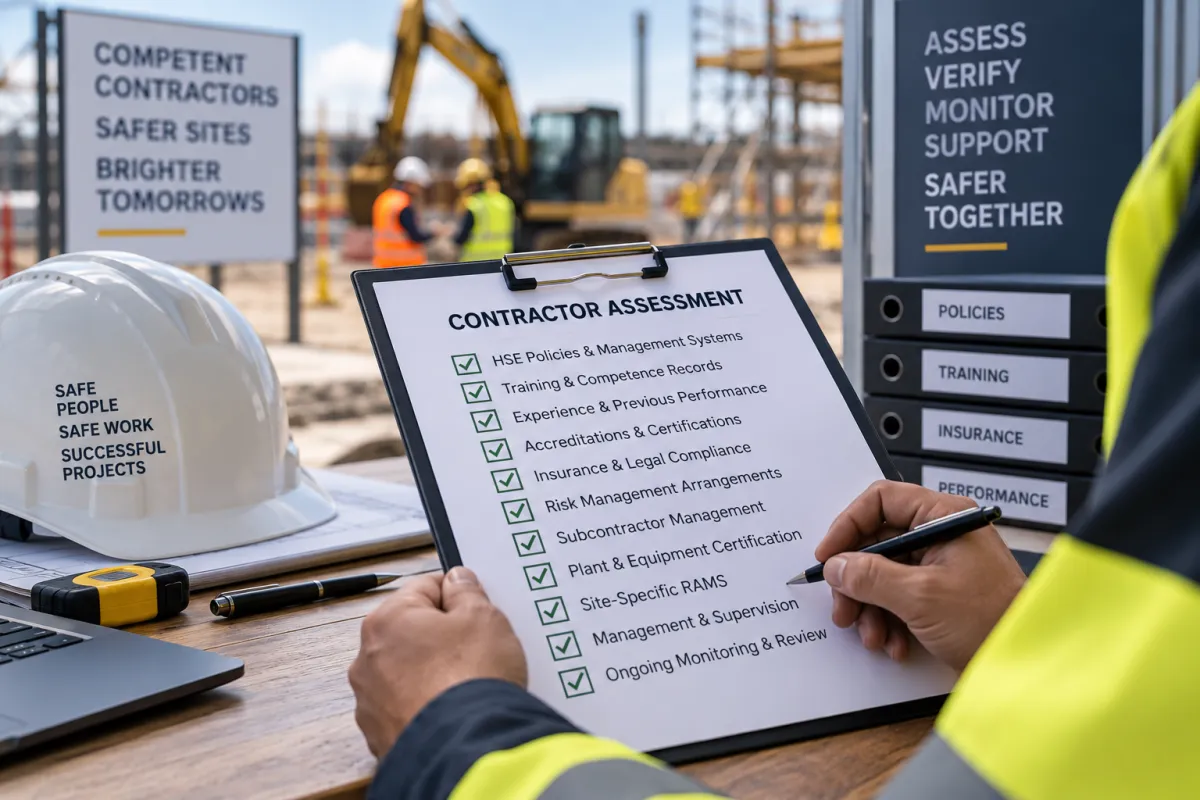
A robust pre-qualification process can provide useful evidence of organisational capability. Depending on the work, this may include:
relevant HSE policies and arrangements;
competence and training records;
previous project experience;
accident and incident performance;
enforcement history;
risk-management arrangements;
subcontractor management;
appropriate insurance and accreditation; and
evidence of suitable management systems.
But documentation alone does not demonstrate how effectively those arrangements operate on site.
A contractor may have an excellent safety management system on paper while implementation at project level is considerably weaker.
That is why contractor assurance needs to continue after appointment.
Verify competence at mobilisation
Before work starts, the organisation should confirm that what was promised during procurement is actually being provided.
This could include reviewing the competence of key personnel, project-specific RAMS, supervision arrangements, training records, plant and equipment certification, emergency arrangements and the management of subcontractors.
For construction work, these arrangements should also align with the relevant duties under the Construction (Design and Management) Regulations 2015, including the requirement for those appointing designers and contractors to take reasonable steps to satisfy themselves that the organisation has the necessary skills, knowledge, experience and organisational capability.
Mobilisation therefore provides an important opportunity to identify gaps before exposure to risk begins.
Monitor what happens during delivery
Competence assurance should then move from documentation to operational evidence.
Site inspections, audits, observations, engagement with supervisors, incident trends and corrective-action performance can help determine whether the contractor's management arrangements are working in practice.
Organisations should consider questions such as:
Are supervisors exercising effective control?
Are RAMS understood and followed?
Are workers suitably trained for the activities they are performing?
Are changes in scope being adequately assessed?
Are subcontractors being controlled to the same expected standard?
Are deficiencies being corrected promptly?
And importantly, is the contractor learning from observations, near misses and incidents?
These provide a much stronger indication of capability than the original questionnaire alone.
Competence can change
Another reason for ongoing assurance is that contractor capability is not static.
Personnel change. Subcontractors change. Programmes accelerate. Work scopes evolve. New hazards emerge, and experienced supervisors may be replaced.
A contractor assessed as capable six months earlier may therefore present a different risk profile today.
Higher-risk projects should have defined triggers for reassessment, particularly after significant personnel changes, repeated non-conformances, serious incidents, major scope changes, or deterioration in HSE performance.
From contractor approval to contractor assurance
The objective should not be to create additional bureaucracy.
It should be to establish a proportionate assurance process that gives the client or principal contractor confidence that organisations undertaking work remain capable of controlling the risks they create.
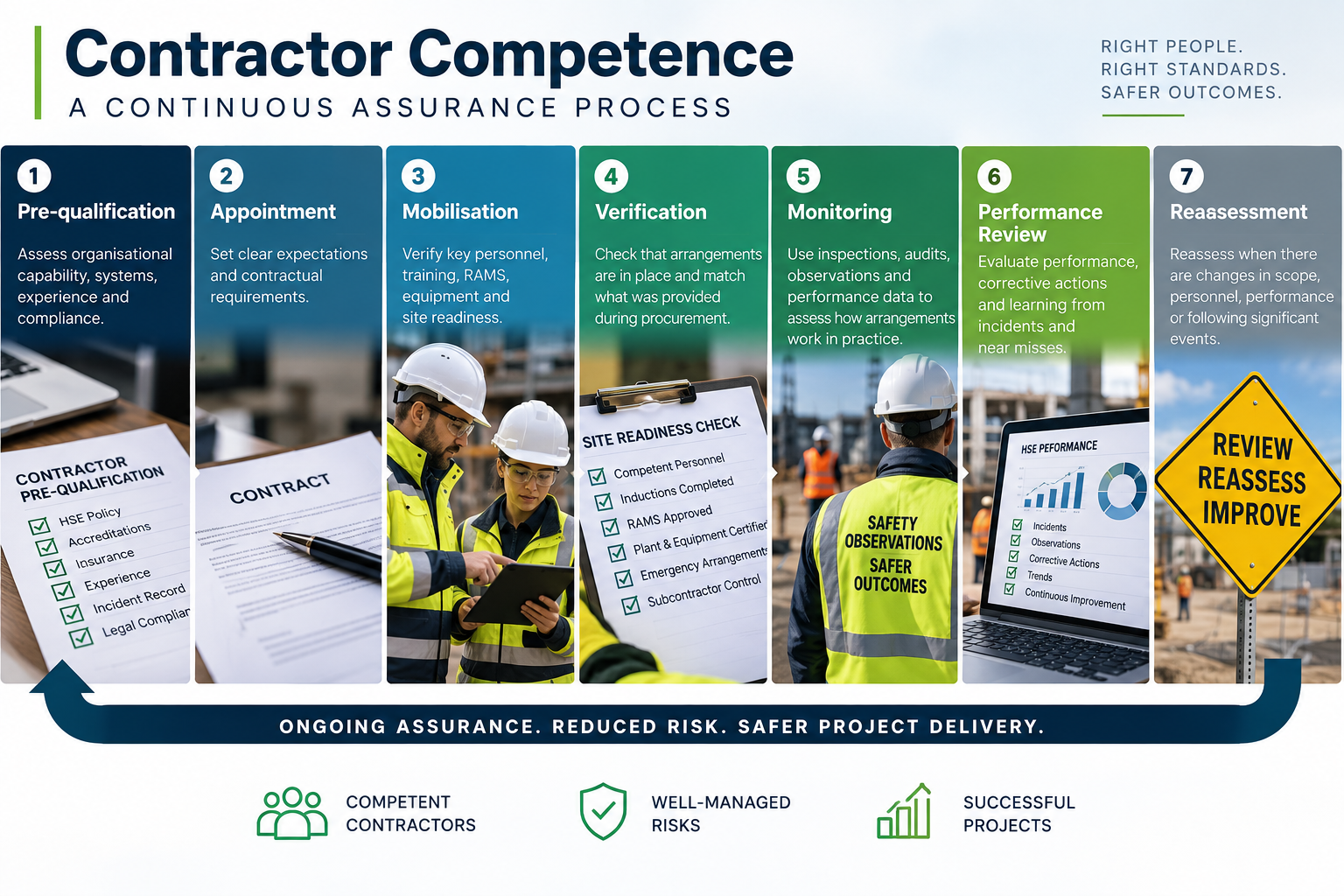
A mature contractor-management framework therefore follows a continuous cycle:
Pre-qualification → Appointment → Mobilisation → Verification → Monitoring → Performance Review → Reassessment
That changes the emphasis from simply having an approved contractor list to maintaining evidence of ongoing contractor capability.
For organisations operating in construction, renewable energy, and other higher-risk environments, that distinction matters.
Effective contractor management is not about collecting more paperwork. It is about obtaining sufficient assurance that the people and organisations undertaking the work can plan it, supervise it and deliver it safely.
PETSAKO Ltd — Safety • Compliance • Assurance
PETSAKO supports organisations with contractor HSE assurance, construction and CDM support, HSE management systems, ISO 45001/14001 gap analysis and renewable-energy HSE.

